
Indie Film Bootcamp (Promo 1) from Double 7 on Vimeo.
Wednesday, February 17, 2010


Tuesday, February 16, 2010
The Production Assistant's Handbook - On the Next Double Down Film Show

Author, Caleb Clark

Almost everyone in feature filmmaking starts out as a Production Assistant. It's the standard gateway to many of the best jobs on set and off. Yet there are very few, if any, resources to explain the job, the expectations or how to do it better.
The Production Assistant’s Handbook is one of those rare resources to help the budding P.A. stay out of trouble and graduate from the bottom ranks of filmmaking. On the next Double Down Film Show we’ll speak with Caleb Clark author of The Production Assistant’s Handbook. (Pssst- download the first ten pages here for free!)
What tools should a budding P.A. never be without?
What should you do if you screw up?
What should you never be seen doing on set?
What’s the secret to locking down of a public street?
How do you get your first P.A. job?
From walkie talkie etiquette to what to carry in your fanny pack, Caleb will help us break down the answer to all these questions and give best practices for Production Assistants. (Yes, fanny packs have never gone out of style for film crew!) Come listen and learn as we once again open the backdoor to film school.
The answer to all these questions, plus more filmmaking inspiration and education on the next Double Down Film Show. Real problems. Real answers. By filmmakers. For filmmakers.
The Double Down Film Show...
Filmmaking Reality Starts Here!
* * * * * * * * * * * * * * * * * * * * * * * * * * * * * * * * * * * * * * * * * *
This episode sponsored by :
* * * * * * * * * * * * * * * * * * * * * * * * * * * * * * * * * * * * * * * * * *
Filmmaking Reality Starts Here!
* * * * * * * * * * * * * * * * * * * * * * * * * * * * * * * * * * * * * * * * * *
This episode sponsored by :
* * * * * * * * * * * * * * * * * * * * * * * * * * * * * * * * * * * * * * * * * *
About the Show:
The Double Down Film Show is an hour long experience of "real talk" about what it takes to get your project from script to screen and establish a career in film and tv. Hosts Anthony Q. Artis of Down and Dirty DV and Pete Chatmon of Double 7 Film will deliver all of the production, technology, business, and motivational support that filmmakers need to achieve their filmmaking dreams. Check out the previous 25 episodes of season #1 on iTunes.
The Double Down Film Show
Every Wednesday, 9pm - 10pm E.S.T.
Call-in Number: (646) 929-1956
Listen to it on your computer
or phone live TONIGHT at 9pm
Stream or Download here:
http://www.blogtalkradio.com/DoubleDownFilmShow
OR
Take it to go and never miss a show:
Subscribe to the iTunes Podcast
Every Wednesday, 9pm - 10pm E.S.T.
Call-in Number: (646) 929-1956
Listen to it on your computer
or phone live TONIGHT at 9pm
Stream or Download here:
http://www.blogtalkradio.com/DoubleDownFilmShow
OR
Take it to go and never miss a show:
Subscribe to the iTunes Podcast
***PS - If you can't tune in live, you can always stream the show or download the .mp3 file later at the site above.
Networking #3- Organizations with a lot of Acronyms
Ok, now you have your business cards and you’re going to some local film screenings or events. Now you can narrow down your venues and activities by involving yourself in film communities.
Film communities are any networks, clubs, venues or anything that is run with the sole purpose of uniting people that have film in common, as well as maybe other characteristics such as gender, location, race, style, level etc. These can all be a great resource since anything related to them can be sure to be film-related and all the people you meet through the communities will be somehow involved in film as well. Oh, they can also be a good tidbit for your resume!
In this article I am going to do an overview of a few big film communities in New York City, or national ones that can also be found in New York City. However, even if you are located elsewhere, most of these will have different branches in different states, so it is still worth looking them up.
Now, I am biased because I am an indie filmmaker as well, so I am going to begin my list with the communities that I am a part of.
Okay, those are the three I belong to. Between all three, I pay about $210 to stay a member every year, which for someone in my position is quite steep. However, I can honestly say I have gotten more than my money’s worth out of them. Notice that I belong to one large organization, the IFP, one that is specific to my gender and location, NYWIFT, and one that caters to my ethnicity, NALIP. Right now I am going to list a few other organizations you might want to consider, but keep this in mind- there are countless organizations of various sizes.
It’s like a college scholarship search: if you’re Gay, Native American, Jewish, a Veteran or whatever, there is probably a film organization that was made with that specific group of people in mind. And if you’re none of the above, then join the big ones and look into other more specific organizations.
Being a member alone is not going to make connections for you, you have to take advantage of the opportunities these organizations can facilitate for you, but you have to participate, ask questions, contribute opinions and hand out cards.

Film communities are any networks, clubs, venues or anything that is run with the sole purpose of uniting people that have film in common, as well as maybe other characteristics such as gender, location, race, style, level etc. These can all be a great resource since anything related to them can be sure to be film-related and all the people you meet through the communities will be somehow involved in film as well. Oh, they can also be a good tidbit for your resume!
In this article I am going to do an overview of a few big film communities in New York City, or national ones that can also be found in New York City. However, even if you are located elsewhere, most of these will have different branches in different states, so it is still worth looking them up.
Now, I am biased because I am an indie filmmaker as well, so I am going to begin my list with the communities that I am a part of.
IFP- Independent Film Project - www.ifp.orgIFP is a pretty all-encompassing community of independent filmmakers. It is the largest and oldest of these organizations in the country, having started out as a program in the 1979 New York Film Festival. It organizes numerous seminars, screenings, events, parties, and workshops all year round and has various opportunities for indie filmmakers to find funding, support, platforms and people. IFP has headquarters in several cities and boasts a website full of useful information. While the $100 a year membership fee might sound a bit steep, this is one club you don’t want to be left out of.
NYWIFT- New York Women in Film And Television - www.nywift.orgNYWIFT is NOT a women-only club. That would not only be stupid, it would be illegal. Instead, it is a non-profit dedicated to supporting and helping women filmmakers in a male-dominated industry. Male members are very welcome, as the mission of NYWIFT is not to have women replace men in the industry but coexist with them. This organization has a very tight-knit community, despite its thousands of members, and a strong drive to help fellow members out. Mixers and events are planned constantly to encourage its members to meet each other and work together. The quality of memberships is kept in check by an application process. Those interested in joining must send in resumes and references in the film industry. Membership is divided in two tiers- regular members who are established professionals who have been in the industry 4 years or more, and Next Wave, where budding filmmakers can take advantage of all membership benefits with the additional support provided to help them succeed.
NALIP- National Association of Latino Independent Producers - www.nalip.org
This is an organization designed to bringtogether and support Latino filmmakers all across the country. While smaller in size and not as event-prolific as the previous two I have mentioned before, this organization still provides some very good resources and networking events. The smaller size of the organization makes the events more intimate and full of familiar faces.
Okay, those are the three I belong to. Between all three, I pay about $210 to stay a member every year, which for someone in my position is quite steep. However, I can honestly say I have gotten more than my money’s worth out of them. Notice that I belong to one large organization, the IFP, one that is specific to my gender and location, NYWIFT, and one that caters to my ethnicity, NALIP. Right now I am going to list a few other organizations you might want to consider, but keep this in mind- there are countless organizations of various sizes.
It’s like a college scholarship search: if you’re Gay, Native American, Jewish, a Veteran or whatever, there is probably a film organization that was made with that specific group of people in mind. And if you’re none of the above, then join the big ones and look into other more specific organizations.
This is the list I came up with. However, wherever you are and whoever you are there are organizations out there that you can rely on. Most of them have membership fees. To make these fees worth it, or even make it worth your time to go to any event, you have to be proactive.
DCTV- Downtown Community Television Center - www.dctvny.orgHoused in the little red firehouse, DCTV is a member-based organization which boasts workshop after workshop after workshop. With a long list of events and seminars, DCTV also provides rentals, screening series, and a special section of resources dedicated to teenage and young filmmakers!
DV RepublicDvRepublic.org is organized and hosted by BFF (aka Black Filmmaker Foundation)
DVRepublic.org exist as a self-validating, self-supporting online community of "citizens" who monitor the intersection of media, technology, and social justice. As informed citizens, we engage in active online discussion in the "public square" of the DV Republic liberated zone.
AAWIC- African American Women in Cinema- www.aawic.org
AAWIC’s title is pretty self-explanatory. With the mission to help the integration of black women in the film industry and to create a better understating of this community, AAWIC provides events and resources for African-American female filmmakers.
NBPC- National Black Programming Consortium- www.nbpc.tvThis is not a membership based organization but more of a distributor of black films that commissions and acquires films made by black filmmakers and about the black community. It can be a great thing to know about and does have very good resources.
DFA- Dance Films Association, Inc. - www.dancefilmsassn.org
Another one of these niche organization, DFA is a member-based organization that seeks to encourage and promote excellence in dance in film and TV. Its efforts include programs screenings and funding, and relies on the support of various big names in the arts, such as Film Society of Lincoln Center and the New York Public Library.
NYFVC- New York Film/Video Council- www.nyfvc.orgWhile not as active than IFP and not as cool a website as NBPC, NYFVC is a great organization that provides monthly events in New York City. Like NALIp, by being smaller it provides a real sense of community in its members and a comfortable environment in which to meet fellow filmmakers. It’s yearly dues are reasonable and the events are frequent.
DocuClub - www.docuclub.org
The only one here without an acronym, DocuClub is a non-competitive community in which documnentarians can pitch and screen their works-in-progress and get help and feedback from the club’s members. Networking ain’t bad either.

Being a member alone is not going to make connections for you, you have to take advantage of the opportunities these organizations can facilitate for you, but you have to participate, ask questions, contribute opinions and hand out cards.
Saturday, February 13, 2010
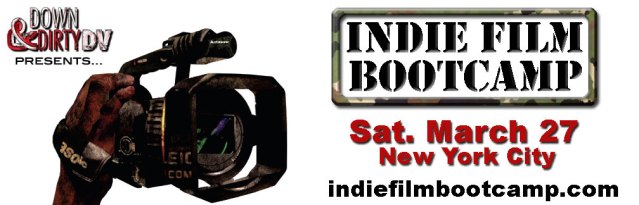
Announcing Indie Film Bootcamp!!!
Filmmakers, What is Nobody Telling You?
It’s a hard fact that some of the most valuable filmmaking knowledge is not really covered in most filmmaking classes and seminars. The insider tips, tactics and techniques that we deliver in this seminar are all things that you will eventually learn if you stay in the industry and keep making films and video.
But the real question is - How will you learn them?…Through the usual expensive trial and error, morale-busting mistakes and years of hard knocks in the trenches? OR By learning vicariously from the shared experience of other independent filmmakers like you that have already been there and done that?
Nobody Told Us Either
Between the three instructors presenting this seminar, we’ve taken our indie lumps several times over. When we started out nobody told us some of the most crucial things we needed to master to become better filmmakers and consistently create professional-quality videos. From the intricacies of wooing an investor to the perils of shooting without permits…we learned it all the hard way.
At Indie Film Bootcamp, you can learn it all the EASY way – from our mistakes and hard-won experience. And not just our mistakes, but also our many indie successes. Between us, we’ve taken multiple top prizes at major film festivals, produced music videos and shows on MTV, been screened on Showtime and Starz, wooed and directed A-list talent, and screened films at Sundance, Slamdance, Tribeca and beyond. However, the reality is that if we knew just half of what we’re now sharing at Indie Film Bootcamp, we could have done it all faster, cheaper and with even better results.
This is Not a Class…It’s a Mission
This isn’t just a supplementary paycheck for us. Educating others is a life-long part of our filmmaking mission. We are so serious about this mission that we produce and host a weekly radio show and podcast just for aspiring filmmakers entitled, The Double Down Film Show, and have even published the best-selling film book on practical digital filmmaking, The Shut Up and Shoot Documentary Guide. Two of us even serve as adjunct film/tv professors at NYU’s legendary Tisch School of the Arts. But none of those venues allows us to tell you everything that we want to share. In these live seminars, we tell you the keys to everything we wished someone had told us at the start of our careers with no B.S. and no holds barred.

If you’re just beginning your filmmaking journey or stalled out somewhere in the middle, we pose the crucial question:
What is nobody telling you that’s holding back your filmmaking progress?
Actionable Knowledge & Advice
We’ve packed more than 25 years of combined indie filmmaking experience into six dynamic seminars that shed light on everything you won’t learn in film school, books and other seminars. We’ll teach you exactly where and how you can take effective short cut’s to save precious time and money, as well as which common amateur filmmaker short cuts will derail your project.
This seminar series will present all the practical filmmaking knowledge that you need to make your films and videos better, faster, and cheaper in a single full-day of:
- SPECIFIC – Insider Techniques & Tactics
- PRACTICAL – Filmmaking Tips and Wisdom
- CANDID – Real-world Advice
- INSPIRATIONAL – Case studies and examples
…All jam-packed into six one-of-a-kind indie filmmaking seminars from three dynamic and unique voices on the indie film scene that have already been there and done that. We’ll teach you everything we’ve learned the hard way….so you won’t have to.
This is a unique opportunity to receive 8+ hours of straight-up practical and real-world advice and get a jump start on the things you most need to succeed from fundraising to guerrilla production tactics to specific digital video tips and techniques. This is knowledge and advice that you can immediately apply to make your projects better, faster, and cheaper.
We’ll Tell You What They Won’t
We aren’t just going to help prepare you for the technical and procedural side of filmmaking. We will also cover some of the most crucial business, social and psychological aspects of the industry that are often overlooked, but have just as much impact on the final product.
We will teach you how to:
- Clearly conceive, plan and EXECUTE your creative vision
- MAXIMIZE production value despite limited resources
- Adopt a BULLET-PROOF indie mindset and philosophy
- Develop a solid STRATEGY for long-term career success
…all detailed from our own personal experience, step-by-step with clear illustrations and examples that you can follow and apply to your own work. But be warned, after you attend Indie Film Bootcamp you won’t be able to say nobody told you.
One-of-a-Kind Filmmaking Seminars
Down and Dirty Filmmaking: Guerrilla Tactics – Professional Results
 An overview of guerrilla film making philosophy, tactics, and procedures that can be applied to any budget, any camera, any time. Learn the mindset and specific practices it takes to maximize your film making resources and increase production value. This is Anthony’s most popular seminar as presented across Europe and at the Annual National Association of Broadcasters Conference in Las Vegas.
Anthony Q. Artis Run Time: 1 hr. 30mins.
Click the link below to view a video clip from this seminar:
Down and Dirty Filmmaking Excerpt – “Attracting Name Talent” from Anthony Artis on Vimeo.
__________________________________________________________
How To Make a $1 Million Video (…without $1 Million)
 Nowadays, anyone can access the tools to make a music video or new media project, but only a few can make them good enough to land paying corporate clients and be aired on major tv networks. Whiz kid video director, Benjamin Ahr Harrison, of Double 7 Film will give you an overview of the cutting edge digital tools, techniques, and practical strategies that can help you make music videos, commercials and other impressive, low cost/high production value videos that blow away audiences and keep clients coming back for more.
Benjamin Ahr Harrison Run Time: 1hr. 20mins.
__________________________________________________________
Documentary Interview Bootcamp
 An A-Z overview of all the facets for conducting a successful interview – from the technical practices of camera, audio and lighting to the practical techniques of planning and conducting interviews. This workshop is perfect for aspiring documentary filmmakers, small businesses, corporate videographers, and video journalists who are looking to expand and sharpen their skill set.
Anthony Q. Artis Run Time: 1 hr. 30mins.
__________________________________________________________
The Psychology & Technique of Directing
 You know the difference between close-ups and tracking shots, you’re familiar with who should be doing what on your set, but what do you do when personalities clash, time is running out, and you suddenly realize that you weren’t as prepared as you thought? This seminar will arm you with the necessary tactics to manage any production and ensure that your creative vision is translated to cast, crew, and most importantly, the audience that will see your film.
Pete Chatmon Run Time: 1hr. 30mins.
__________________________________________________________
Raising Funds and Pitching…Effectively
 What good is a great idea if it never gets off the page? Raising money is the hardest part of filmmaking at every level, nevertheless, we all leave resources untapped due to poor self-promotion, ineffective proposals, and failing to speak the language of the investor, executive, or any other type of person sitting across the table. Being able to secure financing means being able to sell your idea. This seminar will help you streamline your efforts as you embark on the beautiful journey of going from script to screen.
Pete Chatmon Run Time: 1hr. 30mins.
__________________________________________________________
Learn, Break In & Rise Up In The Biz
 No one ever said breaking into the film and tv industry was easy, especially during an economic crisis! If you’ve recently graduated from film school, or are looking to make a career transition, then this seminar is the perfect introduction into the real world of film and TV. This is a one of a kind seminar guaranteed to inspire and motivate and fully-arm attendees with the attitude and counter-intuitive wisdom they need to advance in the film and tv industry. Presented only 3 times in 3 years, Anthony, will reveal his winning 5-step formula for getting noticed and promoted on any job in any field of entertainment or beyond. Using the steps outlined in this seminar, attendees will get a no-nonsense blue-print for better learning their craft, aquiring more power and control over their circumstances and parlaying an entry-level (or even temp job) in the industry into a major career break. This course is highly-recommended for anyone that aspires to work for a major network, studio, production company or other corporate entertainment company.
Anthony Q. Artis Run Time: 1 hr. 45 mins.
__________________________________________________________
YOUR INSTRUCTORS
ANTHONY Q. ARTIS, The Video Evangelist
 Anthony Q. Artis is a 15-year veteran of the film and TV industry and the author of The Shut Up and Shoot Documentary Guide (Focal Press 2007) and the upcoming The Shut Up and Shoot Freelance Video Guide (Focal Press 2011). His features and shows have been screened at the Tribeca Film Festival, the IFP Feature Market, Slamdance, and on MTV. Most notably, Anthony produced the 2003 IFP Feature Market grand prize-winner, Shelter, Associate Produced the IFC-backed feature documentary, Paper Chasers, and served as a Segment Producer for the popular MTV reality series Flipped. He has worked professionally in positions as diverse as producer, gaffer, cinematographer, special-fx make up, sound mixer and location manager. Having established a presence in television and the indie film world, Anthony founded the production and guerrilla film training company, Down and Dirty DV, LLC. As CEO and producer for the company, Anthony has produced dynamic attention-grabbing video projects for TV, DVD and the Web for clients such as Focal Press, Elsevier Publishing, The Clive Davis School of Music and FUSE-TV in
  recent years. Apart from production, Down and Dirty DV, LLC has come to represent a strong international brand of no-nonsense guerrilla filmmaking instruction. The company’s premiere publication, The Shut Up and Shoot Documentary Guide, has been the best-selling film book on Amazon.com and Neilson’s Bookscan list for more than a year now. After less than a year on the market, The Shut Up and Shoot Documentary Guide was adopted as required reading by NYU, Chapman University, and dozens of other notable film schools around the world. Apart from his duties as CEO of Down and Dirty DV, LLC, Anthony teaches as an adjunct film professor at NYU’s, Tisch School of the Arts, where he also manages production equipment for all grad and undergrad Film and TV students.
PETE CHATMON, The Complete Filmmaker
 In today’s age of New Media, writer/producer/director, Pete Chatmon is the guy you want behind the lens. Whether feature filmmaking, commercials, music or viral videos, Chatmon develops content with one focus: to engage and entertain audiences and consumers through honest storytelling. Previous credits include the romantic dramedy PREMIUM, starring Dorian Missick, Zoe Saldana, and Hill Harper, 761st, a documentary on the first black tank battalion in WWII narrated by Andre
 Braugher, and a variety of new media campaigns for clients including Classic Kicks, New York University, and The Salvation Army. Chatmon is also the recipient of the 2008 Tribeca Film Festival “All Access” Program’s Creative Promise Narrative Award for the bank heist screenplay $FREE.99, written in collaboration with Candice Sanchez McFarlane. A graduate of New York University’s Tisch School of the Arts, Chatmon has been featured in Forbes Magazine, Variety, and on Fox Business Channel. Double 7 Film, his film production and marketing boutique, is based in NYC.
BENJAMIN AHR HARRISON – The Video Whiz Kid
 Benjamin Ahr Harrison grew up in America’s most diverse city, Oakland, CA. At the age of twelve he took a summer course in ocean science and decided that his childhood dream of becoming a marine biologist just wasn’t for him. Thereafter, he committed himself fully to his Plan B career of becoming a filmmaker. He attended NYU’s Kanbar Institute for Film and Television Production for his undergraduate education. He is now an award-winning screenwriter and has directed music videos that have screened on MTV and BET, as well as racking up hundreds of thousands of views on YouTube and MySpace. He still maintains a keen interest in ocean and space science, though his taller-than-average build will always stand in the way of his Plan C career: becoming an astronaut. This puts him in the dire position of needing absolutely to succeed in the world of filmmaking.
__________________________________________________________
Location & Schedule
Date: Saturday – March 27, 2010
Location: New York City – West Village/Soho Area (venue TBA by 3/1/10)
Schedule:
9:00am – Down and Dirty Filmmaking: Guerrilla Tactics – Professional Results
10:30am – Break 5mins.
10:40am – How to Make a Million Dollar Video…without a Million Dollars – 1 hr. 20mins.
12:00am – Documentary Interview Bootcamp 1hr. 20mins.
1:20pm – LUNCH BREAK
2:20pm – Psychology and Technicality of Directing – 1 hr.
3:20pm – Fundraising & Pitching – 1.5 hr.
4:50pm – 10min. Break
5:00pm – How to Learn, Break In, and Rise Up in Show Business – 1.5 hr.
6:30pm – Q&A (15mins.)
7:30pm – After Party (ca$h bar)
__________________________________________________________
Get Tickets
At major conferences and institutions across the country, you would easily pay $200.00 or more for 8+ hours of hard-to-find info like this. But we’re guerrillas like you and know it’s a recession, so we’re giving you 50% OFF the going rate, so everyone can afford to invest in their filmmaking future.
6 seminars, 3 speakers, 8+ hours
Only $99.00
Early Bird Discount Ends March 6th!
After February 28th price will increase to $120.00
*Price includes exclusive film training and job resource handouts. Please note that due to high demand and group pre-registrations, there are a very limited number of seats for this premiere seminar series.
FREE Giveaways Just for Registering Early
Each Wednesday leading up to the event we new will raffle off a chance to win one of 4 valuable filmmaking prizes on The Double Down Film Show, but only up until March 6, 2010. So if you’re slow, you blow. Here are the rewards of being early:
- Signed DVD of Pete Chatmon’s indie feature “Premium” starring Avatar’s, Zoe Saldana and Hil Harper.
- Signed copy of “The Shut Up and Shoot Documentary Guide” by Anthony Q. Artis – the #1 film book on Amazon.com and Neilsen’s Bookscan List!
- A DVD of the Independent Feature Market Grand Prize-winning drama, “Shelter”, produced by Anthony Q. Artis
- One hour of consulting w/ Anthony Q. Artis ($150 value!)
- One hour of consulting w/ Pete Chatmon ($150 value!)
One winner will be announced each Wednesday night until all prizes are gone.
We hope to see you all there!
-Anthony, Pete and Ben
Thursday, February 11, 2010
Everyone's A Producer

Often times indie filmmakers glean whatever techniques they find useful from traditional producing. Well, in times when producing and distribution have gone topsy turby, one always needs to be open to new ideas. Well I just want to share some innovative methods that have been getting some attention and some success.
Last month’s Rotterdam Film Festival saw producer Rutger Wolfson including entire audiences into the fundraising of a film. Imagine that: every person in every seat turned into a co-producer for your film!
To see how he did it, check out the explanation of his “coin” method in the full article here.
Wednesday, February 10, 2010
From Project Fizzle to Indie Sizzle - The Double Down Film Show Returns TONITE!
CLASS IS NOT CANCELED DUE TO SNOW
Winter break is over and the new semester is in full effect which can only mean it's time for another season of The Double Down Film Show! Season 3 kicks off with the return of our very first guest, indie filmmaker, Jameel Saleem.
- What common problems plagued his first feature effort?
- How did he land the money and make a new film in less than a year?
- What did he do different the second time around?
- Why didn’t he just quit like so many others?
The answer to all these questions, plus more filmmaking inspiration and education on the next Double Down Film Show. Real problems. Real answers. By filmmakers. For filmmakers.
The Double Down Film Show...Filmmaking Reality Starts Here!
Cream Soda
The Good, The Bad and The Movie
Listen Live Every Wednesday 9pm-10pm E.S.T.
Call-in Number: (646) 929-1956
Listen Live or Download Later Here:
http://www.blogtalkradio.com/DoubleDownFilmShow
OR
Take it to go and never miss a show:
*PS - If you can't tune in live, you can still stream the show or save the podcast to your iPod later at the site above.
Friday, February 5, 2010
Guerrilla Film Marketing for Werewolves
My man, Sam Thompson, director of the Slamdance film, "There's a Werewolf in My Attic", who I met briefly at Sundance a few years back just launched a simple fun campaign to promote and sell his newest horror flick "Living Arrangements".
I'm reposting it here because I think it's an excellent case-study in no-budget film marketing, promotion and self-distribution. Making a a film you're proud of is great, but I think it's pretty damn pointless, if you don't also take great pains and efforts to make sure that an audience actually finds and sees it.
As indie filmmakers I think we should all be as saavy as Sam and come up with clever (not necessarily expensive or even overly-time-consuming) ways to get people interested in our projects. Congrats to Sam for fine filmmaking hustle.
Peep Sam's guerrilla marketing approach:
The Trailer for "Living Arrangements":
I'm reposting it here because I think it's an excellent case-study in no-budget film marketing, promotion and self-distribution. Making a a film you're proud of is great, but I think it's pretty damn pointless, if you don't also take great pains and efforts to make sure that an audience actually finds and sees it.
As indie filmmakers I think we should all be as saavy as Sam and come up with clever (not necessarily expensive or even overly-time-consuming) ways to get people interested in our projects. Congrats to Sam for fine filmmaking hustle.
Peep Sam's guerrilla marketing approach:
The Trailer for "Living Arrangements":
Filmmaking...Any Monkey Can Do It!
 A while ago in the NY Times there was a long article about how chimpanzees are so smart they could almost talk. Naturally we are curious what they would say. Well, since that didn't work, we figured we would try to communicate in other ways and see what kind of movies they would make. Check out the full article, aptly titled "Chimpanzees Discover Guerilla Filmmaking" about what the chimps made of their op in the director's chair, other than fling poo at the camera.
Sunday, January 31, 2010
The Intersection of Filmmaking and Video Games: Part I
What is the nature of the relationship between the video game and film industries? The media landscape has changed incredibly since the early days of Atari and Nintendo. As video games have increased in number, quality, and audience, the lines dividing games and films has blurred. Today, the video gaming and film markets feed off of each other, and often work in tandem as part of multimedia, cross-platform marketing.
This blog is the first in a two part series examining the relationship between film and video game production. Part I provides a history of video game design, while Part II examines the current relationship between film and video game production.
Part I: A Historical Examination
Early Failures: As the Los Angeles Times notes in this article, the relationship between film companies and video gaming began when well-known companies like Warner Communications and Lucasfilms began their own interactive media branches. In the 1970s, Warner Communications bought Atari, while companies like Lucasfilm, Walt Disney Co., and DreamWorks branched out into interactive gaming in the '80s and '90s. These early forays into video game production were ill-fated, however, in part because film production companies didn't understand the medias' inherent production and narrative structure differences.
Many film companies underestimated video game production time lines, and thus released less-than stellar games like the infamous "E.T. the Extra-Terrestrial", which was created in just 5 weeks. Overproduction, coupled with poor graphics and repetitive game play led to Atari's loss of a whooping $100million. The game's failure is considered one of the contributing factors to the "video game crash of 1983."
Video Game Resurgence:
The 1990s saw a rebirth of video game technologies, with the introduction of 3D environments and optical disc storage, which were able to store larger amounts of data cheaply. The 1990s also witnessed the creation of the 'interactive movie,' a video game format that utilized "full-motion video of either animated or live-action footage." This genre--which utilized Laserdisc technologies--followed a 'cinematic' storyline, and featured either animated characters or real actors. Gamers were prompted to decide the actions of the main characters, and their decisions would trigger the playback of particular film clips. In 1982, the video game "Rollercoaster" was released; it included playback of scenes from the film of the same name. A year later Cinematronics released "Dragon's Lair," a game so successful it inspired two sequels and additional platform releases, including a recent re-release on BluRay.
This blog is the first in a two part series examining the relationship between film and video game production. Part I provides a history of video game design, while Part II examines the current relationship between film and video game production.
Part I: A Historical Examination
Early Failures: As the Los Angeles Times notes in this article, the relationship between film companies and video gaming began when well-known companies like Warner Communications and Lucasfilms began their own interactive media branches. In the 1970s, Warner Communications bought Atari, while companies like Lucasfilm, Walt Disney Co., and DreamWorks branched out into interactive gaming in the '80s and '90s. These early forays into video game production were ill-fated, however, in part because film production companies didn't understand the medias' inherent production and narrative structure differences.
Many film companies underestimated video game production time lines, and thus released less-than stellar games like the infamous "E.T. the Extra-Terrestrial", which was created in just 5 weeks. Overproduction, coupled with poor graphics and repetitive game play led to Atari's loss of a whooping $100million. The game's failure is considered one of the contributing factors to the "video game crash of 1983."
Video Game Resurgence:
The 1990s saw a rebirth of video game technologies, with the introduction of 3D environments and optical disc storage, which were able to store larger amounts of data cheaply. The 1990s also witnessed the creation of the 'interactive movie,' a video game format that utilized "full-motion video of either animated or live-action footage." This genre--which utilized Laserdisc technologies--followed a 'cinematic' storyline, and featured either animated characters or real actors. Gamers were prompted to decide the actions of the main characters, and their decisions would trigger the playback of particular film clips. In 1982, the video game "Rollercoaster" was released; it included playback of scenes from the film of the same name. A year later Cinematronics released "Dragon's Lair," a game so successful it inspired two sequels and additional platform releases, including a recent re-release on BluRay.
Friday, January 29, 2010
What Mao Zedong and Napster Have in Common

In an article in the New York Times on Tuesday, Jan 12, 2010 John Tierney addresses digital piracy from two people who helped propagate it in the first place: Jaron Lanier and Dr. Lieboweitz of University of Texas in Dallas. They were loud advocates for the Free Information movement of the 80’s, when internet began and a sparkling future of possibilities opened up. And yet, it wasn’t long before both changed their minds.
Tierney explores the points of view of these two men in regards to the free web’s effects on piracy of intellectual property of all kinds and the effects that piracy has had on the very essence of the intellectual property created.
At first Jaron’ s views are laid out. Views that compare the effects of the internet with political communism, where the media material one makes is for all to share, or even Feudalism where the media material is made in a peasant-like way for Lord-like mega sites like YouTube to run on. He compares the mentality of Internet users to “hive” mentality, where none are thinking individually and a mob is formed. This “destructive social construct” revolves around the acceptance that any kind of artist or writer or creator of intellectual property should resign their work over to the masses, gaining no monetary credit for their labors.
Lanier blames this construct on a form of software Lock-In, where archaic practices are kept in use because new and improved ones are too expensive to implement.
Dr. Liebowitz, much like those annoying piracy commercials they used to play in movie theatres before the previews, believes that while most people are not thieves and would not steal a CD from a store, they do not see piracy as stealing. Instead, they justify it with the ideologies that information should be free for all.
According to Liebowitz, though, this ideology is propagate by the lack of disciplinary action taken against pirates. If you try to take a CD from (I was going to say Virgin Megastore, but never mind) Best Buy, the beeper thing goes off at the door and you are prosecuted for shoplifting. If only there were stronger punishments, there would be less piracy. However, there is one big problem with that, which Liebowitz acknowledges. As Tierney puts it “when the majority of people feel entitled to someone else’s property, who is going to stand in their way?”

I personally blame the word "piracy". Well, not entirely, but I think if it was called “thievery” and not piracy, we would associate it more with being behind bars than with Captain Sparrow.
I agree with Liebowitz, more than I do with Lanier, but I still disagree with some of his arguments. For example, he claims “an intelligent person feels guilty for downloading music without paying for it”. Um, no, not necessarily. Those who don’t create intellectual property themselves often don’t fret with their conscience at all about downloading something off Limewire. And even if “an intelligent person” does feel guilty, we are talking about the majority of the world.
I will quote the wisdom of the Men in Black (notice I give credit to them):
J: People are smart, they would understand…
K: A person is smart. People are dumb, stupid wild animals, and you know that.
ANTHONY'S TAKE: Christa, is much more thoughtful and philosophical on this subject than me. I'm from Baltimore, so I take a little more gully approach to the issue of people stealing that which I've worked hard to create. I think the best deterrent is the Tupac approach...

(Click the link or picture above for video.) Bootleggers would think twice if more people handled their business like Pac.
Subscribe to:
Posts (Atom)


 Posts
Posts


