Friday, June 16, 2006

The First Feature Film Shot On a Cell Phone

Check out how Down and Dirty they get in Italy. Italian filmmaker's Marcello Mencarini and Barbara Seghezzi shot their feature-length doc, "New Love Meetings" on a Nokia cellphone. I shit you not.

The movie is an updated version of the 1965 Italian documentary, "Love Meetings", by Pier Paolo Pasolini. They shot some 700 interviews using a Nokia N90 cellphone that holds about 1 hour of video and whittled the footage down to 100 interviews with people discussing their love and sex lives and attitudes about sex. The whole thing cost them a few thousand dollars, most of which was spent on travel an hotels.

They are still exploring options for distribution. Undoubtedly, all the attention their unique choice of recording medium has garnered will make distribution much more likely, similar to the unfolding story of the "Four-Eyed Monsters" team which I posted back in January.

No it ain't a High Def XDcam, but they've got compelling content, a completed feature film and publicity splashed across the pages of USA Today, Yahoo News, Showbizdata.com and I'm sure a dozen other major publications around the world. I don't know about you, but I think that's a damn good result having started with an idea, a cell phone and a few thousand bucks.

Click here to read the USA Today article on "New Love Meetings".

Yet another example of how imagination, creativity, and let's face it- outright balls, can trump a lack of money and traditional resources. That people is the essence of the Down and Dirty DV philosophy...

It doesn't take money to make films, it takes resources.

Stop trying to mimic the methodologies of maintream filmmakers that have more cash and resources than you'll ever have and start trying to figure out ways to maximize the resources you do have at your disposal. Focus on the content. Get creative with your execution and storytelling and you will get results. As Sly and the Family Stone would say...

Free your mind and the rest will follow.

(Or was that the Staple Singers?) Either way, Barbara and Marcello are bonified straight-up guerrillas. 'Til next time. I'm out.

-Ant.

Thursday, June 15, 2006

What the Hell is Machinima...and Why Should Aspiring Filmmaker's Care?

Simply put, it's the latest hypest in filmmaking. I honestly, don't know much about it, but my friend, Skye, sent me a link to a machinima contest sponsored by Intel and I've been hearing some buzz about it for the past few months.

In short, it's a new form of filmmaking using video game technology to create worlds, control actors and camera angles and moves. The new Activision game entitled "The Movies" employs this technology to allow you to choose actors, settings, props, add dialogue, music and then control and record the action in real time. It's like directing a blockbuster without ever leaving your laptop. And as they say in Hollywood, "this baby has legs!" (Unfortunately, it's currently P.C. only, so us evolved Mac users can't check it out. However, there are other machinima tools and software out there.)

Machinima technology has been used for awhile now to do animated storyboards for complex action scenes in big budget movies, but somewhere along the line someone must've realized that if they spruce up the graphics and added some more features that the animated storyboards could actually be the movie, although obviously not a Hollywood blockbuster. Nevertheless, several machinima films have actually competed in film festivals.

The good folks over at machinima.org have a great short Flash introduction to machinima at www.machinima.org/whatis.html. And the site machinima.com has a huge array of info, tutorials and streaming and downloadable machinima movies.


Here's a machinima film by Byrche Wroot entitled "Lover, You Should've Come Over" that was created using Activision's "The Movies" game. It's an excellent example of the storyboarding and storytelling possibilities that machinima has opened up for us digital guerrillas. I don't know about you but I'm impressed an intrigued.


Could this be the future of filmmaking? Was the poorly received Pacino film, "S1mOne", in which a producer slips a "virtual actress" into his film unbeknownst to an adoring public, actually onto something?

I don't have a clue, but my guess is that as technology improves and video game technology becomes more and more life-like (See Xbox 360 or Playstation 3) the possibility is definitely there. I'm not saying that Angelina Jolie is going to be replaced by the "real" Lara Croft anytime soon, but come time for Tomb Raider - Part 5, Angelina might get a run for her money... by a computer-generated character that doesn't require a trailer or a $20 Million dollar paycheck.


Seriously though, I don't know that machinima will dramatically change the film game, but I do think it is an exciting new genre that's worth paying attention to. It's certainly intriguing and sounds like a great way to practice filmmaking and try out different shots and action sequences without all the real-life expense and hassle. No doubt some of tomorrow's great directors will have played out their entire masterworks on computer before a single frame is even committed to camera.

Please post a comment if you are down with machinima and let people know about your experience or other machinima filmmaking resources out there. Most interesting development... stay tuned.

-Ant.

In case you don't click on the comments below, here's some additional resources from Booklad and Tom Jantol both of Premiere Machinima:

More info:

Machinima Premiere

Academy of Machinima Arts and Sciences

Wikipedia entry on Machinima

And a few favorite films:

The French Democracy

Person2184

Only the Strong Survive

Toybox

Saturday, June 10, 2006

Anthony's Film Book Shelf 1

You can't learn this game without putting your head in some film books. What's on my film bookshelf? CLICK ON this interactive Flickr photo to find out my recommendations for gaining guerrilla knowledge.

Thursday, June 8, 2006

DIY Ring Lights

Add a little sparkle to your subject's eyes with a homemade ring light. What's a ring light you ask? Well it's a circular shapped ring of lights that mounts around your lens to give a nice even glow to your subject. More notably, the reflection of the ring-shaped lights, literally adds a brilliant sparkle to your subject's eyes.

I believe they are commonly used for macro still photography, but they are also used in video for commercials, glamour shots, and music videos. Professional units run in the hundreds, but if you're on a Down and Dirty budget, you can build your own for less than $50.

Peep out this DIY tutorial from fellow blogger, Joseph Holst, who is a still photographer out of St. Louis. It's a work in progress, but I think the pix and descriptions are more than enough to pull it off. If you're not afraid of electricity and powertools, give it a go or see if you can talk one of your more "D.I.Y." friends into helping you. It's a cool thing to have in the arsenal to add some production value to your more flashy shoots. Click the link below for the tutorial. Peace.

Joseph Holst's Ring Light Tutorial

(Photo: Ring light effect as seen on Joseph Holst. Source: Jyoseph.com)

Wednesday, May 17, 2006

The Power of Podcasting

These Kids Are Very Visible... ...thanks to podcasting. A few weeks ago I came across a podcast called "Invisible Children" that was set up by 3 high-school students (or possibly recent H.S. grads) that did a documentary of the same name.

The documentary is about children who are forced to fight in the war in Uganda. Like many other issues in Africa, the problem has largely been ignored in the U.S. until this incredibly driven group of young people decided that they would try to stop the war. How can 3 high school students stop a war in Africa you might ask? Simple... they started by harnessing the incredible power of podcasting to drive a national campaign to raise awareness of the issue an raise money.

Their efforts are chronicled in regular video podcasts which feature scenes from the doc which is still being cut and behind-the-scenes footage of their hustle to make it all happen. (You can also subscribe to the podcast by searching iTunes podcast directory.) Apart from the power of podcasting, "Invisible Children" also represents a great case-study in guerrilla video activism. These young filmmakers who want to make a difference started with a little doc and expanded their efforts into podcasting, house parties, town-by-town public screenings, merchandising, a national tour... even a video musical to raise awareness of their issue.

Follow their case-study and make a donation at the site. It's worthy cause and just may rekindle that idealistic young filmmaker that still lives somewhere deep in your soul.

-Ant.

Tuesday, May 16, 2006

Down and Dirty DV Raincover

Down and Dirty DV is all about teaching you to make the most of whatever you've got to work
with and finding


low-cost effective solutions to everyday filmmaking problems.

Video cameras and water don't mix. However, sooner or later, we all have to deal with
shooting in the rain or not getting our shot. Rain covers are often a pricey and
low-priority accessory for guerrilas. Here's a very simple alternative to keep your
camera dry when it drizzles. It's virtually cost-free and will take you less than the
time to read this article to actually do.

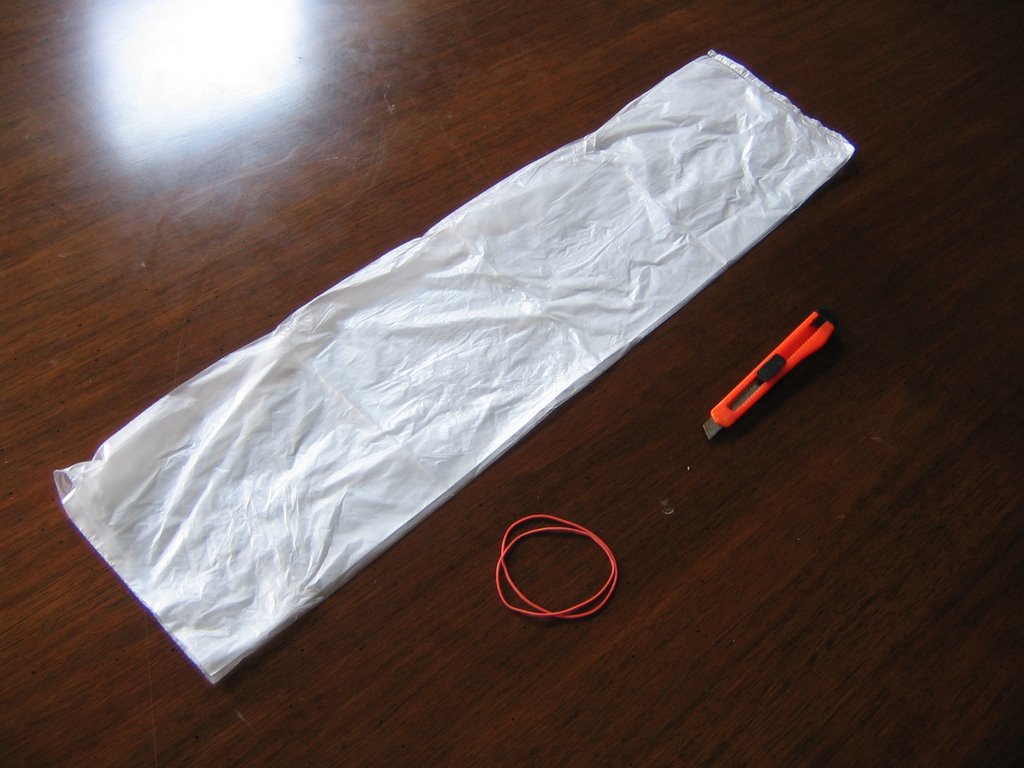
Guerrilla Recipe - 30 Second Down and Dirty DV Raincover


Ingredients:

1. Clear Plastic Bag

2. Rubberbands

Utensils:
1. Razorblade or scissors to slice bag

Instructions:


1. Get a clear plastic trash liner. Those plastic bags from the vegetable section
of the grocery store might work as well if they're big enough. Cut about a 4" slit
in the side of the bag (just big enough for your hand to fit through).


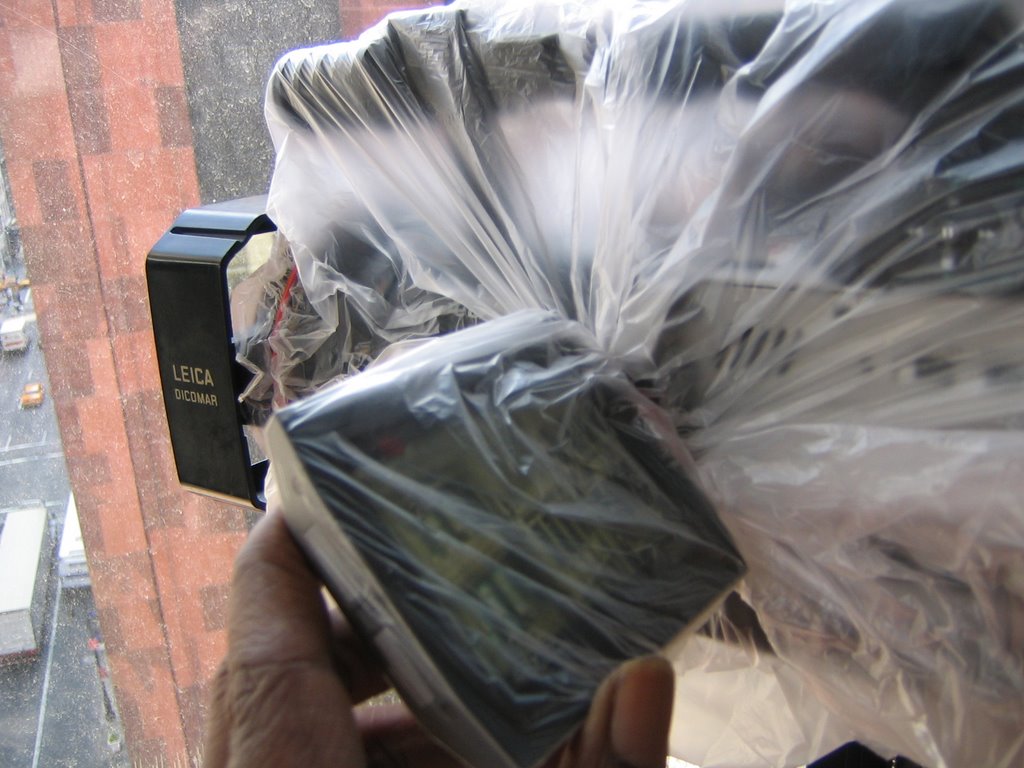
2.Place the camera inside so that the lens is facing out the opening of
the bag and the slit you cut is at the bottom of the camera.


3.Secure the bag around the lens hood/shade with a rubberband so that only
the lens glass is left exposed. Smooth out the plastic over the lcd flipout
screen and secure with a seperate rubberband.

4.Slip your hand in the bottom and shoot like normal.

Additional Tips for Shooting in Wet Weather:

-It's always best to still have an assistant with an umbrella for heavy rain.
-Use 2 bags for extra protection.
-Dry off any exposed parts of the camera that get wet ASAP after shooting.

Total cost of professional raincover = $85.00
Total cost of the down and dirty raincover = $.33


If you find this type of info helpful, holla back at a brotha and let 'em know with
the handy "comments" buttons below any of the blog posts. Happy guerrilla filmmaking,
y'all.
Peace, Love and Video,
-Ant.

Saturday, May 6, 2006

Check Out the New Student Filmmaker Mag


Down and Dirty DV Hits the Print Pages

I forgot to tell you, I've got an article in this month's premier edition of Student Filmmaker Magazine. It's about guerrillla tactics for Feeding Your Crew. I don't think it's available online yet, but if you are a qualified student or aspiring filmmaker, you can get a free subscription by clicking
here.

Tuesday, May 2, 2006

A More Flexible Dolly Solution

This Dolly and Track are HOT!!!

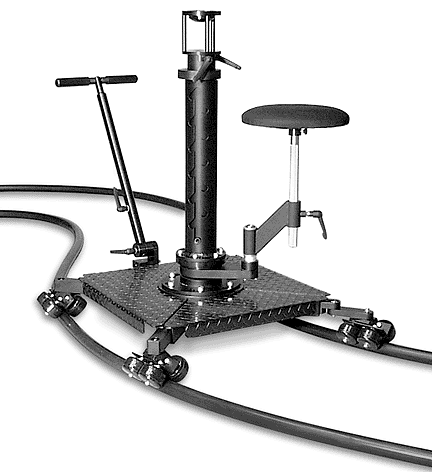
Last year at NAB I had a chance to play with this dolly and track and I was thoroughly impressed, so I thought I'd give it a belated shout out. What's so special about it you ask? Two things:

#1 Flex Track
($400.00 / 40' section)
Instead of normal me
tal dolly track or PVC piping, this dolly uses what's called "flex track" which is essentially a 40' piece of solid rubber tubing that you can double over to make a 20' run or get another piece to make a 40' dolly run. ($400 ea.)

#2 Losmandy Spider Dolly ($1000-$3500)
This dolly goes together like an erector set with several different configurations and has special arms for the 2 sets of wheels
that swing in or out by several inches to smoothly adjust to various track widths. (*$3500 as pictured here)

So What?
Flex Track? Swinging wheel? So what you say? So What?! So What?! I'll tell you so what...This thing is revolutionary, especially for us urban guerrillas. Few things add more production value or eat up more time on set than prepping and executing dolly shots. The standard method/equipment requires infinite fussing with tracks and bumps and substantial storage/transportation space. That's the old school dollies. This dolly/track system does away with some of the most prohibitive dolly shot hassles. Let me break it down:

#1 Both dolly and track are highly portable.
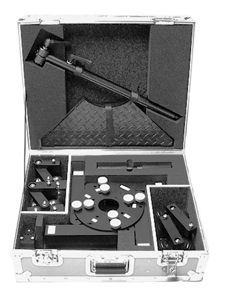
The surprisingly sturdy dolly is modular and breaks down into a small suitcase. The track rolls into a neat (if heavy) coil. This means you can fit it into an ordinary car or even the subway rather than the back of a van or truck.

#2 The track can be laid and ready to go in minutes.
The special swinging arms on the dolly wheels allow you a wide margin of error (up to several inches apart) when laying the track, you can literally throw track down a
nd eyeball whether it's evenly spaced and the dolly will still roll smoothly. Plus, no seams means no bumps.

#3 You can pull off a variety of curves, circles, or straight moves all with the same track.
Traditionally, you'd need to rent curved track as well as straight track to do this and even then, the curved metal track still wouldn't allow you as many creative configurations as the flex track.

#4 The dolly can easily be configured into a walk-along, sit-down, or jib set-up.
You can start with a basic set-up and add on as you go,
depending on your needs and budget. I think this makes it ideal and flexible for budget-conscious student programs or bigger-budget professionals.

For more info peep out the Losmandy Flex Trak and Spider Dolly pages.

I'm out 'til next time.

-Ant.


Friday, April 28, 2006


Will This Camera Change the Filmmaking Forever?

Arguably the hottest product at NAB this year was the Red Camera designed by Jim Jannard, founder of the Oakley glasses company. Although, they were only showing a non-working prototype, the mere concept of Jannard's camera is revolutionary.

Format Type(s) HD+
Resolution(s) 4k. 2k. 1080, 720, 480
Frame Rates Variable: 1-60fps (2540p, 4k, 2k, 1080p, 720p) 1-120fls (2k, 720p)
Medium FireWire 800/400, USB-2 and eSATA interfaces
Lens Mount Interchangeable
Image Sensor 12 Mpxl CMOS
Audio Inputs 4 channel uncompressed, 16 / 24 bit, 48KHz
Dimensions Unknown
MSRP $17,500
Street Price Unknown

I'm a big proponent of technology, because it's the driving force that's made filmmaking more democratic. However, I'm not much of a techno-geek, so I'll try to explain why this camera is so hot in the crudest of layman's terms.

In short, if this camera delivers on it's specs, it will essentially shoot images that are 4 times the quality of the current crop of $3000-$10,000 Mini-DV cameras and twice the quality of the higher-end pro cameras that are currently in it's price range (approx. $20K-$30K w/ lens) such as Sony's XDCam and Panasonic's F900 series. Now dropping $20K-$30K may seem like a lot of dough... okay it is a lot of dough, but it's an incredible value for what this camera is promising to deliver.

Think of it as if someone told you could buy or rent a Ferrari for the price of a Jetta. Yeah, it's kinda like that.

The image sensors on this camera are larger than anything out there. It can be used with 35mm and other professional film lenses. (Which means incredible depth of field.) This camera is capable of shooting in what I believe is being dubbed as "Super HD". What does that actually mean? It means it records a picture that's twice as good as the best HD TV out there. The picture is so good that we don't even have the technology to see how good it is yet! That's a helluva camera. Check out these links below for more precise and geeky explainations:


Wednesday, April 26, 2006


What's Up With the Book?

I just wanted to give everyone a quick update on the debut "Down and Dirty DV: Vol. 1 - Documentaries" book. The project has really taken off and expanded from
my original concept. At the time of this writing my page count is 245 with somewhere in the neighborhood of 100 photo illustrations, line-drawings, and diagrams.

As you probably already know, I am self-publishing this book in true guerilla fashion. My release date was supposed to be this month, but I've decided to hold off until school is back in in September.

There are a couple of reasons for this. #1, I'm just burnt out after a year and half of writing, shooting video and setting up all the business ends of the Down an
d Dirty DV Project and I want to take the summer to slow down a little, let my editor, Darren, finish working his magic on the book and put together a full marketing and launch plan and arrange for some focus groups to help me tweak the contents to the specific needs of today's digital guerrillas.

The other big reason is that a major company has recently expressed some interest in distributing the book on a much wider scale than I'd ever be able to accomplish on my own. So I'm talking to them to see if we can work out the deal numbers to form a win-win situation (see last post). The whole thing will involve lawyers and consultants and lots of fun hours combing through contracts, so I need the extra time to explore wider distribution options.


When I worked on the movie "Paper Chasers", Flavor Flav gave us some great financial advice... He said,


"Try to find people that want to make money WITH you and not people that want to make money OFF of you."


In short- look for the win-win. That's a simple criteria I apply to every potential business deal. (Yes, I re
alize the irony of quoting Flavor Flav on financial advice, but good advice is good advice regardless of the size of the clock around the person's neck who's giving the advice.)

So this summer will be dedicated to getting the book business and marketing plan fully in place, completing the Down and Dirty Documentary-Making DVD, and pumping out some video podcasts, and revamping and expanding the website. Everything is taking a little longer than anticipated because the project keeps evolving and I'm only one man doing this part-time outside of my day gig and family duties but I've got a great team of advisors and allies and fellow guerrillas who are all helping me to make this a truly revolutionary project. I really want to shake some things up in film instruction, but I gotta do it right. Same as with a film. All will be revealed soon enough then you'll understand why it took so long.

Peace.
-Ant.